

In 1991, a Romanian religious scholar named Ioan Petru Couliano was shot dead in a University of Chicago bathroom stall — a murder that remains unsolved to this day. Before he died, Couliano had spent his career arguing that Renaissance magicians like Giordano Bruno were the ancestors of modern mass media. They were, essentially, engineers of the imagination who understood that controlling the images in someone's mind means controlling what they want, fear, and believe.
In this first episode of The Inner Empire, we trace that idea from Bruno's 16th-century theory of "bonds," through a French king's use of court spectacle to pacify a country at war with itself, to the algorithms currently deciding what shows up in your feed. The techniques haven't changed. What's disappeared is the magician.
Below is the adapted transcript of episode 1.
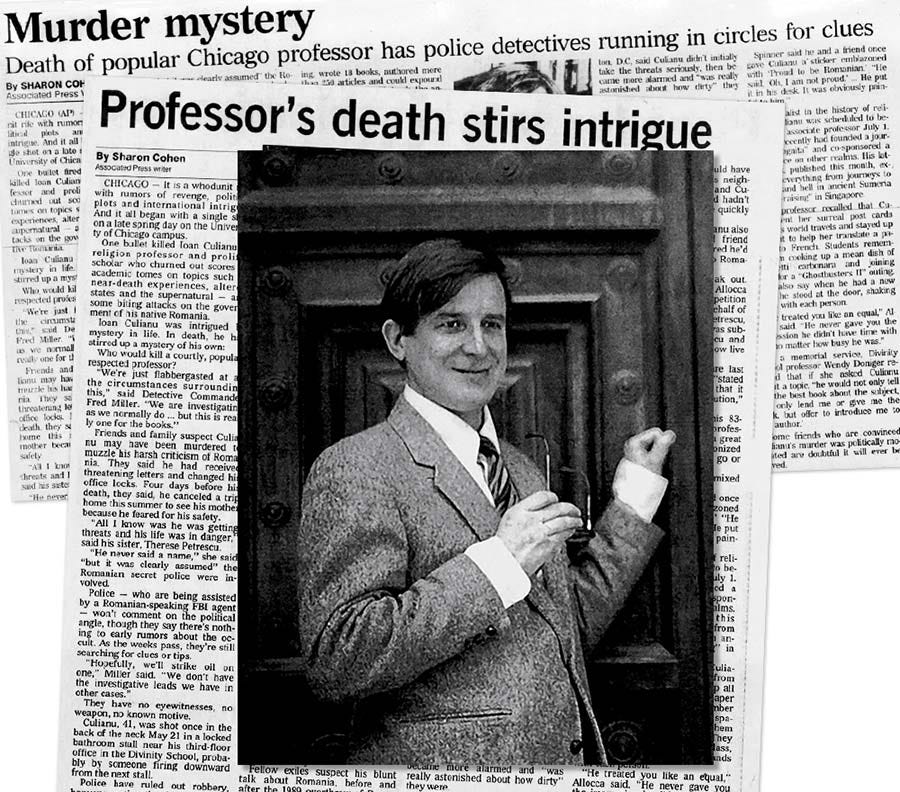
May 21, 1991. University of Chicago. The Divinity School’s annual book sale. The building is crowded, students and faculty moving through hallways, checking tables, exchanging pleasantries. A seemingly normal day. Somewhere in the middle of all that, someone walks into a second-floor men’s restroom, enters the stall next to a professor named Ioan Petru Couliano, climbs up onto a toilet seat, points a small-caliber pistol down through the gap, and fires once.
One shot in the back of the head. The assassin just walks away. Nobody saw him arrive. Nobody sees him leave.
The FBI and the Chicago Police Department investigate. They have theories: a disgruntled student, a jealous colleague, an occult fanatic, a political assassination ordered from overseas. They consider a homosexual lover, a drug deal gone wrong, a mugging inside a bathroom stall. The police district that handles the case averages around two hundred murders a year. This one was unlike any they had encountered. There was virtually no evidence.
The Cook County medical examiner notes the absence of stippling around the entry wound, which means the gun had been held at least eighteen inches from Couliano’s head. The bullet entered the occipital area, clean enough that it looked like a mob-style assassination. The killer had a remarkably steady hand.
The case has never been solved.
Couliano was forty-one years old. A rising scholar at the University of Chicago Divinity School, he was popular, prolific, and, in the weeks before his death, increasingly outspoken about the failures of post-Communist Romania. He had received death threats. His friends and colleagues, including Andrei Codrescu and Saul Bellow, suspected an assassin from the Romanian Securitate. Others suspected domestic fascists with ties to the old communist security apparatus. Either way, this was the first political assassination of a professor on American soil.
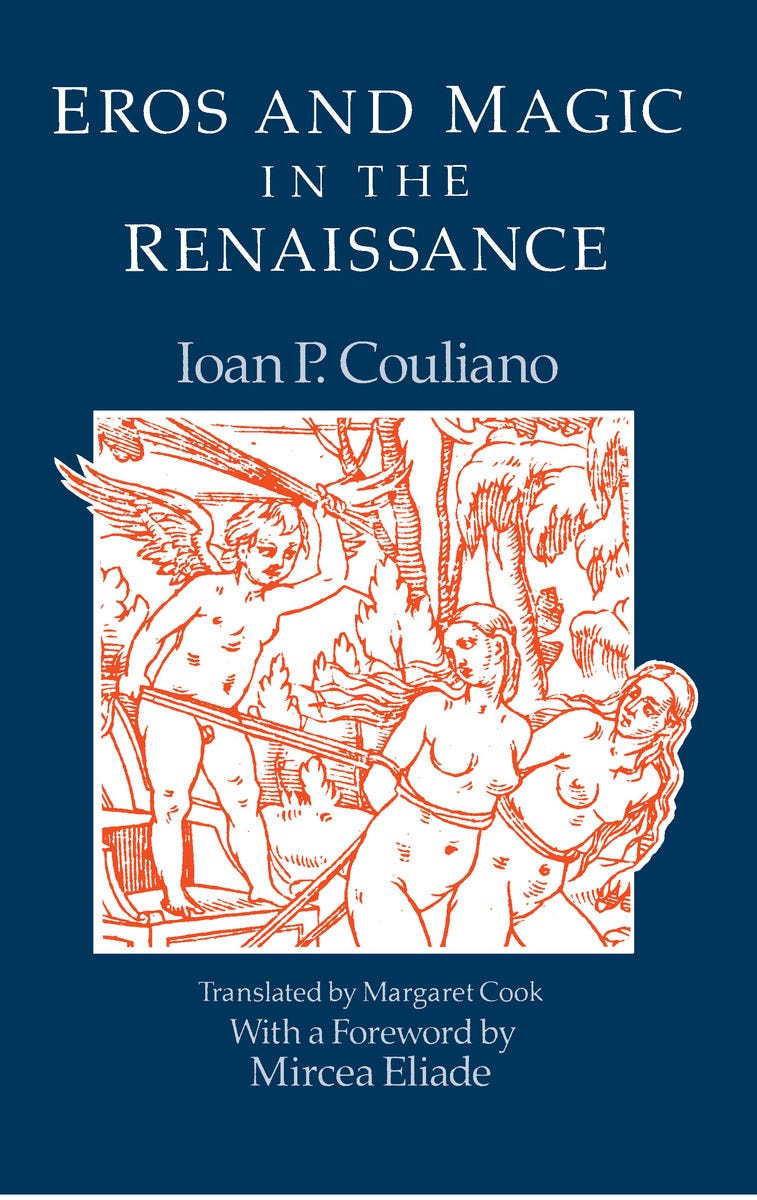
Couliano was a Romanian exile, a protege of the great historian of religions Mircea Eliade, and by the time of his death, one of the more original thinkers in the field of religious studies.
His major scholarly work, Eros and Magic in the Renaissance, is not a light read. But it presents an argument so audacious that it has not stopped resonating in the thirty-plus years since he wrote it.
When you set aside spirits, demons, and magical spells, Couliano argued, the magicians of Renaissance Europe were engineers of the imagination. They understood that human beings perceive reality through internal images — what they called phantasms — and that if you could control those images, you could control how the world appeared to them. You could control what people wanted, what they feared, what they believed was possible.
“Magic … is theoretically a science of the imaginary, which it explores through its own methods and seeks to manipulate at will,” the professor wrote.
This was not folk magic. This was not superstition. This was, in Couliano’s framing, an early form of applied psychology — a technology of consciousness.
He focused on three figures: Marsilio Ficino, the Florentine philosopher and translator, who developed an intricate theory of how spirit, or spiritus, mediates between the body and the soul, carrying images inward through the senses; Pico della Mirandola, Ficino’s wealthy disciple; and Giordano Bruno, the most radical of the three, executed by the Inquisition in 1600 for a series of teachings at odds with the Catholic Church — things like reincarnation and the fact that other galaxies had their own suns and, potentially, their own forms of life.
Bruno took the ancient art of memory — the classical technique of placing imagined objects in imagined spaces to retain information — and turned it into something else entirely. He wasn’t trying to remember things. He was trying to restructure how a person perceived reality. In texts like De Vinculis in Genere, which translates as Of Bonds in General, Bruno laid out a system for binding the will, the imagination, and the attention of other people. The “hunter of souls,” as he called the magical practitioner, works through images rather than arguments, through desire rather than logic. The main entrance for all magic processes, Bruno wrote, is phantasy — the imagination, the only gateway for internal mental states.
Ted Anton summarizes the stakes in his biography of Couliano: “Bruno claimed to raise the ancient Greek art of memory to a level of global emotional control. Culianu claimed that Bruno’s lesser-known text [Of Bonds in General] predicted in detail the means by which a modern population could be controlled through imagery. Today, Culianu said, we call this magic psychology, propaganda, corporate public relations, spin control, and advertising.”
The process that sits at the center of our culture, where it manages the flow of information, shapes emotional associations, decides what images get amplified and which get suppressed, is not a new invention. According to Couliano, the Renaissance magician is the prototype of the impersonal systems of mass media, indirect censorship, global manipulation, and the brain trusts that exercise their occult control over the Western masses.
He was writing this in 1987. He had not yet seen the internet.

The Renaissance magicians taught that repeated images, charged with emotional intensity, installed themselves in the imagination. And once they are accepted in the imagination, they begin to shape perception. This is an automatic process. You don’t argue someone into a new reality. You give them images that carry emotional weight — images that connect to desire, fear, disgust, longing — and you repeat them, install them, until reality reorganizes around them.
Another term for this process is subjective synthesis, borrowed from the ceremonial magician Joseph C. Lisiewski — an engineer, alchemist, and ceremonial magician who lived in rural Pennsylvania and spent decades making the same argument Couliano was making, from the opposite direction. Where Couliano was a historian working backward from Renaissance texts, Lisiewski was a practitioner working forward from grimoires. Both arrived at the same mechanism for defining one’s reality: attention, association, and expectation.
Attention determines what enters the system. It shapes what you notice, which means it shapes what is real to you. Association links what you attend to with existing emotional and cognitive structures, building coherent interpretive frameworks. Expectation governs what you anticipate, which in turn shapes what you see, what you do, and what you believe is possible.
Install the right images with the right emotional charge, repeat them consistently, and you don’t have to persuade anyone of anything. The framework runs itself.
Anthropologist T.M. Luhrmann, in her research into evangelical Christian communities, documented this process. Practitioners learned to pray by using their imagination to see, hear, smell, and feel their way through biblical scenes until the content registered as perceptual experience. The technique is called interweaving. It layers religious content with memory until the distinction between the two collapses. Luhrmann found that practitioners with a high capacity for psychological absorption — the ability to become fully immersed in mental imagery — were six hundred percent more likely to report hearing God’s voice or feeling God’s presence. But absorption alone wasn’t sufficient. Practice mattered. The more time someone spent in this type of prayer, the more reliably these experiences occurred.
The brain processes vivid mental imagery through the same neural pathways as actual sensory experience. When an imaginary figure is consistently visualized, supplied with sensory specificity, and emotionally charged, the image stabilizes. The effort required to maintain it diminishes. Eventually, it arises spontaneously, and at that point, it no longer feels imaginary. It feels like an encounter with something outside you.
Couliano understood this. What he was describing in the Renaissance magicians was a systematic method for producing and reproducing exactly this effect — not in one person kneeling in a chapel, but in entire populations.
“Magic action occurs through indirect contact,” he wrote, citing Bruno, “through sounds and images which exert their power over the senses of sight and hearing. Passing through the openings of the senses, they impress on the imagination certain mental states of attraction or aversion, of joy or revulsion.”

Someone is interested in UFOs — he’s been watching videos on the subject for weeks. He also has trouble sleeping. One video mentions that disrupted sleep can be a symptom of “missing time.” He watches it twice. The algorithm notes the replay. It serves another video on missing time, then one on hypnotic regression, then a testimonial from someone who recovered memories of contact after years of unexplained insomnia. A specific narrative of the self has been installed — not through argument, not through persuasion, but through repetition and emotional pairing.
The user did not choose this narrative. They were brought to it.
This is a design outcome, documented in the academic literature and in the public record of internal corporate research. Social media algorithms are designed to increase engagement by surfacing the most emotionally activating content — content that produces what the platforms’ own internal metrics measure as strong emotional responses. Filter bubbles are not accidental. The most inflammatory content achieves the greatest visibility because inflammatory content holds attention.
Yaël Eisenstat is a former CIA counter-extremism analyst who later worked at Facebook because she was worried about the platform’s effect on political discourse. In a TED talk, she explained how social media companies make money: they segment users and feed them personalized content that validates and exploits their biases. Their bottom line depends on provoking strong emotions to keep people engaged, which often means rewarding the most inflammatory and polarizing voices.
TikTok’s “For You” page works the same way. It tracks how long you watch a video, what you skip, and what you replay. That data builds an individualized profile, and the app uses it to deliver content calibrated to you with increasing precision. The feed isn’t a neutral reflection of what exists. It’s a curated sequence engineered to keep you watching.
By 2016, Facebook’s News Feed function depended on one of the world’s most secretive predictive algorithms, drawing on more than one hundred thousand elements of behavioral data, continuously computed to determine the personal relevancy score of thousands of possible posts. One hundred thousand behavioral variables, continuously computed for every user, at all times.
And what does this system do with all that data? It decides what images to put in front of you, in what order, paired with what emotional context, and at what moment. It manages the sequence of your attention. It determines which impressions land and which are filtered out. It shapes what feels obvious, what feels urgent, and what feels real.

The French Wars of Religion ran from 1562 to 1598. The country was a veritable slaughterhouse, split between the Catholic League and the Protestant Huguenots. Neighbors killed neighbors. Massacres wiped out any trust between communities. There was no shared national identity left to appeal to. Military force couldn’t fix this. Cold logic couldn’t fix this. People were gripped by apocalyptic thinking, fear of divine punishment, paranoia. Standard medieval statecraft had nothing for a situation like this.
So King Henry III innovated. What he did lines up almost exactly with Giordano Bruno’s theory of bonding.
Henry knew you couldn’t reason this population into peace. So he went after their imaginations instead. He staged elaborate court spectacles: ballets loaded with esoteric symbolism, massive royal processions into hostile cities known as Joyous Entries, all of it synchronized down to the detail. His Palace Academy studied how music and symbols move people, and he used that research.
He wasn’t just acting as king. He was presenting the monarchy as a living symbol of cosmic order, of reconciliation. He buried the ugly facts of civil war under spectacle, betting that the sheer visual force of unity would hook people’s hunger for peace and pull their loyalty back toward the Crown.
Henry III had invented an early version of modern political propaganda. He treated statecraft as a kind of applied psychology. He studied his court’s specific fears and vanities and used that knowledge to bind them to his agenda, the same way an operator studies a mark. His spectacles didn’t end the violence — that job fell to his successor, Henry IV — but his method showed a real grasp of how the subconscious works.
Centuries before mass media, before modern PR, Giordano Bruno saw how a population locked in ideological war could be redirected, if only for a moment, through a calculated assault on the senses.
Social media platforms run the same basic operation now, just without a king and without anyone deciding to do it. The algorithm doesn’t need to know anything about anyone. It just measures what makes you stop scrolling and serves you more of it. The bonding still happens. The senses still get hijacked before the mind can weigh in.
Nobody is running the Palace Academy anymore. The system runs itself.
Bruno had a method. He worked deliberately. He studied correspondences — the symbolic links between planets, metals, emotions, and images — and he used them consciously, as a practitioner. The system required skill, intention, and practice. There was a magician at the center of it.
Couliano traced how that tradition evolved. The magician became the propagandist, the publicist, the spin doctor, the media executive. The techniques were industrialized. They were scaled. But there was still, somewhere, a person making decisions — a practitioner behind the curtain.
What happened next? The practitioner disappeared. Not because the techniques stopped working, but because the techniques were automated. The feeds, the recommendation engines, the engagement loops: these are magical techniques, running without a magician. Nobody is steering them toward any particular end. They optimize for engagement, which means emotional activation, which means they have automated exactly the mechanism Bruno identified and Couliano theorized — and then kept it running after everyone went home.
Does this explain why I feel so… hollow… after too much time spent doomscrolling on Instagram? Unlike Henry III’s Joyous Entries, there is nothing joyous about my social media feed.
Ioan Couliano was killed on a busy afternoon in a crowded building. No one saw the shooter. The case remains unsolved after thirty years. His friends suspected the Romanian secret police, the Securitate. His colleagues suspected domestic extremists. Chicago detectives suspected a mugging, or perhaps a jilted lover.
What nobody suspected, in 1991, was that the problem he was working on — how to hijack the imagination at scale — would turn out to be the problem. The question Couliano was circling — the question he did not live to answer — was what happens when the mechanism scales past any individual practitioner’s control. What happens when the techniques are so thoroughly embedded in everyday life that they no longer require conscious intent, from anyone? What happens when nobody is running the system, because the system is running itself?